How long We Were Here Tomorrow takes, sector by sector
12–15 hours for a first campaign pass. The developer's 'around 15 hours of content' is the slow end of our six sector timings, not the average; completionists should budget 18–22.
A first run takes 12 to 15 hours. The developer's "around 15 hours of content" is the top of that band, not the middle: add up the six sectors and the slow end lands exactly on 15. A pair that narrates what it sees and does not re-solve rooms lands nearer 12. Budget three evenings, not one.
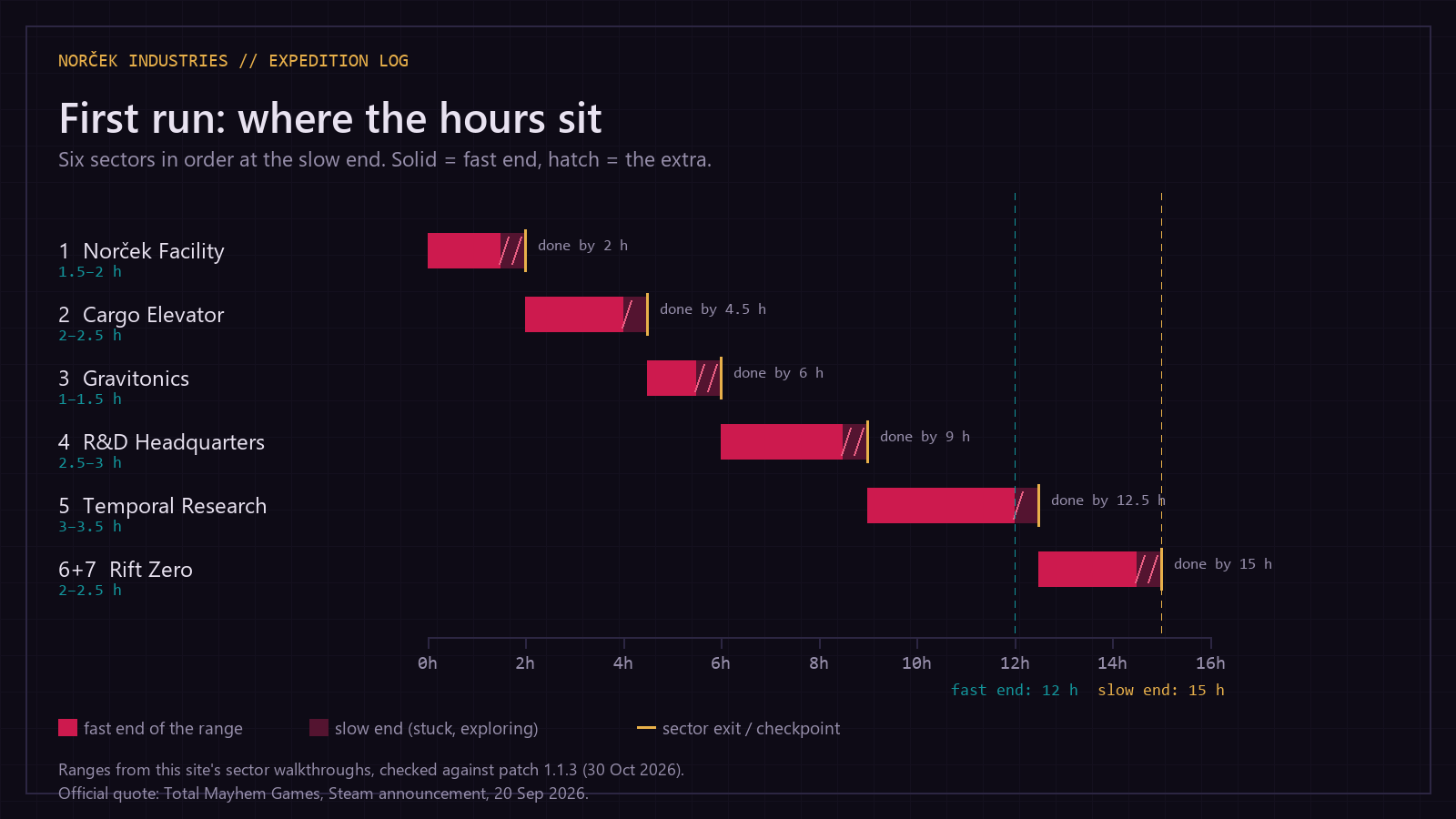
Chart made for this site from the sector walkthrough timings and the 1.1.3 build; no publisher artwork used.
Pairs with: Walkthrough · Checkpoints and reloads · One-run achievement route
The four numbers worth knowing
| What you are planning | Hours | Where the number comes from |
|---|---|---|
| Story run, pair that talks well | 12–13 | Sum of the fast end of each sector range |
| Story run, average first-timers | 13–15 | Sum of the slow end of the same ranges |
| Story run, unhurried and stuck a few times | 15–18 | Above, plus one long stall and one reloaded evening — our estimate, not a measured run |
| Everything: 37 achievements, both endings | 18–22 | One campaign pass plus finale and cleanup replays — estimate, explained below |
The four hours between 12 and 15 are almost entirely conversation, not content. Everyone walks the same corridors and turns the same valves; what separates the two ends is how quickly two people turn what they see into a sentence the other can use.
Every sector, timed
| Sector | Run | Done by | Share of a 13.5-hour run | What eats the clock here |
|---|---|---|---|---|
| Norček Facility | 1.5–2 h | 1.5–2 h | ~13% | Learning the read-back habit under low stakes |
| Cargo Elevator | 2–2.5 h | 3.5–4.5 h | ~17% | Three sub-systems that must be touched in order; the targeting array is the first real wall |
| Gravitonics | 1–1.5 h | 4.5–6 h | ~9% | The shortest sector; most of its time is stair navigation, not puzzles |
| R&D Headquarters | 2.5–3 h | 7–9 h | ~20% | Building-state resets; one power puzzle alone runs about twenty minutes |
| Temporal Research Centre | 3–3.5 h | 10–12.5 h | ~24% | The longest sector: power restoration, the construction site and the loop |
| Rift Zero, chapters 6 and 7 | 2–2.5 h | 12–15 h | ~17% | The finale, where a cold restart costs the most |
Two things fall out of this table. The middle of the campaign is not where the time is: Sector 3 is a corridor between two long sectors, and a pair that treats it as a milestone will feel ahead of schedule and then lose that lead in Sector 4. And the last quarter — Sector 5 plus the finale — is over 40% of the campaign. If you only have two hours on a weeknight, that is the stretch to leave alone.
Why 15 is the ceiling, not the average
The "around 15 hours" line comes from the studio's own release-date announcement on 20 September 2026, a month before launch: "With around 15 hours of content, We Were Here Tomorrow will be our biggest We Were Here adventure yet." It is a content estimate written before anyone outside the studio had played the finished build, and it matches the upper edge of the sector timings rather than their centre.
The arithmetic is not subtle. Fast ends: 1.5 + 2 + 1 + 2.5 + 3 + 2 = 12. Slow ends: 2 + 2.5 + 1.5 + 3 + 3.5 + 2.5 = 15. The number in the announcement is the second sum. Treat it as "a pair that explores and gets stuck will take about this long", which is a useful planning figure and a bad prediction of your own run.
There is no difficulty setting to shorten the game, so the only lever you control is how fast information crosses between the two screens. That is the whole reason the callout rules exist, and the reason a 12-hour pair and an 18-hour pair can have identical puzzle knowledge.
Where the hours actually disappear
Three costs account for almost all of the variance.
Describing instead of pointing. One player sees a panel, the other sees the room it controls. If the first player says "it's the blue one" and there are three blue ones, the second player will try all three. The puzzle mechanics page calls this the description convention; in time terms it is the single most expensive habit in the game.
Undoing work. Resets and reloads are charged at full price in this campaign. Sector 4 is the clearest case: a generator network reset after a successful battery charge wipes a route you rebuilt by hand, and the generator guide treats Y07 as a terminal for exactly that reason. Sector 2's fuse behaviour before 1.1.2 was worse — a failed puzzle could delete a fuse and turn one bad attempt into a dead run.
Finding the next door. Sectors 3, 4 and 5 are vertical and branching, and the staircases in Gravitonics deliberately send you somewhere you did not choose. None of that is puzzle time, and all of it is in the 12–15 hours.
Fast pair, slow pair
| Habit | Fast pair | Slow pair | Hours it moves |
|---|---|---|---|
| Before touching anything | Both describe the whole panel first | One pokes, the other watches | 1–2 |
| Wording | Shape, count, position, state | Colour words that do not survive the lighting | 1–2 |
| When stuck | Name the failed assumption, test one change | Repeat the same attempt louder | 2–3 |
| Notes | One player writes the "before" state down | Nobody remembers what changed | 1 |
| Breaks | Stop at a checkpoint icon | Push through a room they cannot see | 1–2 |
The last row is the one people ignore. A tired pair at hour four makes the same mistake three times and calls it a puzzle. The checkpoint rule on checkpoints and reloads exists for this: stop after the icon, not in the middle of a mechanism.
A session plan that fits the checkpoint rule
Checkpoints mostly land when a puzzle is finished and the pair enters the next room, so chapter boundaries are the natural cut points. Three evenings:
| Evening | Sectors | Hours | Stop after |
|---|---|---|---|
| One | Norček Facility, Cargo Elevator | 3.5–4.5 | The targeting array and the move into Gravitonics |
| Two | Gravitonics, R&D Headquarters | 3.5–4.5 | The prototype upgrade at the end of Sector 4 |
| Three | Temporal Research Centre, Rift Zero | 5–6 | The ending — do not split this one |
The finale is the exception to every "take a break" rule. Chapters 6 and 7 share one continuous run beyond the Rift, and the Rift Zero page recommends against carrying it across two evenings: the puzzle logic depends on state you built in the same session. Two shorter evenings work better than three even ones, because the first five sectors can absorb a break and the last one cannot.
If you have a weekend rather than evenings, one long Saturday for Sectors 1–4 and a second for Sectors 5–7 matches the same shape with more slack.
100% is a different budget
The campaign pass banks 36 of 37 achievements, and the missing one is the opposite Rift Zero ending — a finale replay from a late checkpoint, not a second playthrough. On top of that, the achievement route flags two decisions that can force a return trip: spending the Fuse in Sector 2 closes the Many Ways route, and the collectible plushies can be missed room by room.
In hours, that is one campaign plus a short finale replay plus whatever cleanup you left behind. Our estimate is 3 to 5 extra hours, and it is an estimate — nobody has published a completionist time for this build. If you are going for 100%, decide the Fuse question before you pull it, because that single choice is the difference between a ten-minute return and a two-hour one.
What patches changed about the clock
The 30 October 1.1.3 patch is the first one that saves time rather than fixing crashes:
- An extra checkpoint at the laser puzzle in Sector 3, which shortens the redo after a late failure.
- A save icon at every checkpoint, so a pair can see the save before quitting instead of guessing.
- Role swapping at any checkpoint, which removes the old worst case: reaching a tool-specific room with the wrong player carrying the tool and replaying the chapter to fix it.
- The Offices of Tomorrow checkpoint now tracks progress between sessions, which matters for anyone who stops mid-sector.
Earlier, 1.1.2 removed two time sinks that used to be pure loss: fuses in Daphne's Lab no longer vanish when the puzzle fails, and the checkpoint-loading black screen is gone. Nothing in either patch changes puzzle length itself. The four comfort settings in 1.1.3 change how the HUD reads, not how long a room takes.
How long is We Were Here Tomorrow?
12 to 15 hours for a first campaign pass. The developer's pre-launch figure of "around 15 hours of content" matches the slow end of our sector timings, so most pairs finish nearer 13 unless they explore or stall.
How long does each sector take?
Norček Facility 1.5–2 hours, Cargo Elevator 2–2.5, Gravitonics 1–1.5, R&D Headquarters 2.5–3, Temporal Research Centre 3–3.5, and Rift Zero 2–2.5 for chapters 6 and 7 together. Sector 3 is the short one; Sector 5 is the long one.
Can you finish it in one sitting?
Not comfortably. Twelve hours is the fastest realistic pass, and the finale should not be split across sessions, so a single sitting would mean playing the first five sectors tired. Two or three sessions keep the last stretch sharp.
Does a difficulty setting change the length?
No. There is no difficulty menu and no assist mode that shortens puzzles. The 1.1.3 comfort settings change the HUD — vignette, reticle size, HUD border and border anchors — and leave the puzzle work untouched.
How long is the second ending replay?
One finale checkpoint, not a second campaign. The other Rift Zero ending is a decision at the end, so the replay is measured in minutes once you are back at that checkpoint. Both endings and the achievement they gate are covered on the endings page.
Is it longer than We Were Here Forever?
Yes, by the developer's own framing: Tomorrow is described as their biggest We Were Here adventure, and Forever ran roughly 10–12 hours. The extra time is concentrated in Sectors 4 and 5, which together are about half the campaign.
What this page cannot confirm
Per-chapter times from the developer — the campaign has never been given an official chapter clock, and the chapter numbers themselves come from the 1.1.2 patch notes rather than a published contents page. There is also no speedrun dataset for this build, so the 12-hour floor is the fast end of our own sector ranges, not a record. The "unhurried" and "100%" rows are estimates built from those ranges; they are labelled as such because a stalled evening can add more than any table predicts. Our sector ranges were read against the 1.1.3 build on 4 November 2026, and the patch notes are the place to check whether a later update moves a checkpoint.