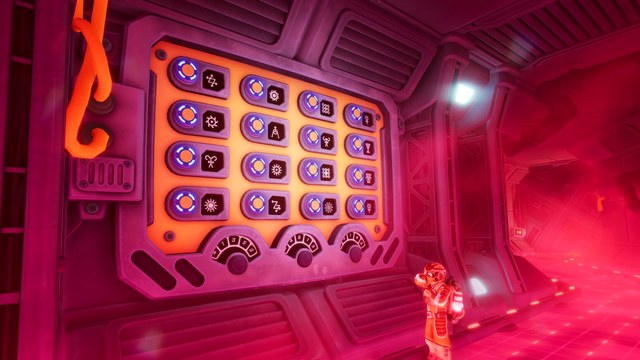
What each Explorer sees, and what to say
The player who can see names the object; the player who can act says what they need. The four tool achievements split by gun rather than by choice, so one pair can bank all four in a single campaign.
Every room in We Were Here Tomorrow hands the two of you different information, and the game never says which kind of gap you are looking at. The working rule is one sentence: the player who can see names the object, the player who can act says what they need — and neither of you describes something the other one cannot find. Below is that rule applied sector by sector, the four pieces a usable callout carries, and which of you banks which tool unlock.
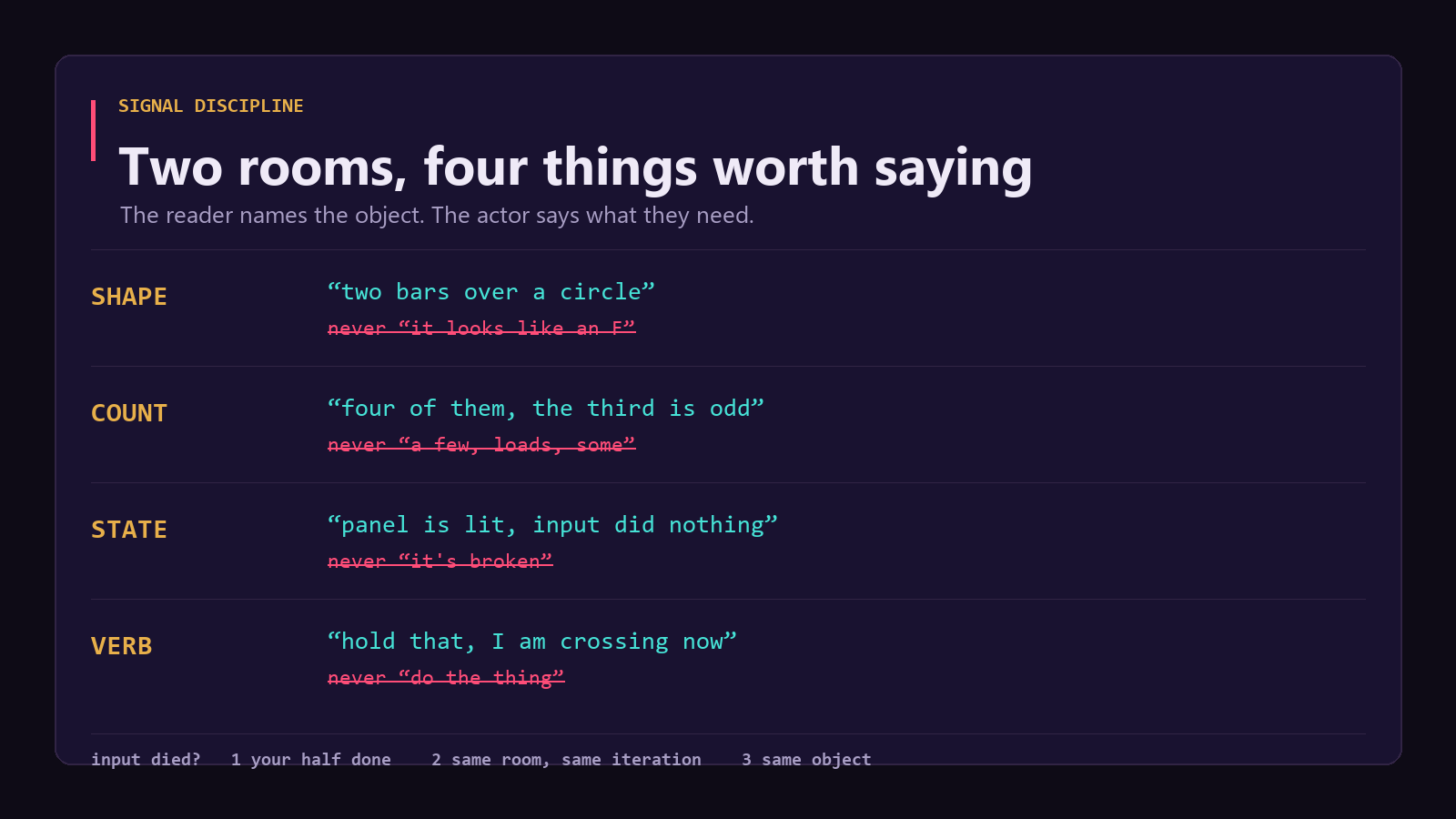
Card made for this site from the six sector pages; no publisher artwork used.
Pairs with: Puzzle mechanics · Voice chat · Achievement route
Who is blind to what, sector by sector
The four-way split in the mechanics page — information, location, state, capability — is the theory. This table is the field version: what actually differs on your two screens, and the sentence that unsticks it.
| Sector | What differs between your two screens | Who is working blind | The callout that fixes it |
|---|---|---|---|
| Norček Facility | The same panel read from two angles — a symbol that reads as a letter to you reads as a different letter to your partner | whoever is not standing at the panel | shapes and counts, never letter names |
| Cargo Elevator | One of the two rooms is lit and the other is not, and the array terminal sits away from the stabilizer | whoever holds the terminal, because the field state lives in the plant room | "field is stable or not stable" first, position second |
| Gravitonics | The same staircase at two orientations; vertical separation also kills line of sight | the player on the lower level, almost always | "which floor are you on, and what is above you" |
| R&D Headquarters | The panel reports a state the room has already left, and the two of you are on opposite sides of a building | whoever is reading the panel, until a baseline is agreed | "read me the list in order, I am writing it down" |
| Temporal Research Centre | Part of the information is audio, and a loop can leave each of you in a different iteration | both of you, at different moments | "what is still in your hands?" then one silent loop |
| Rift Zero | The loudest room in the game, and the only one where a single decision is one-shot | both, because you will talk over the ending | "commit or close — say it now" |
The pattern is worth carrying: in the first two sectors the gap is light and position; from Gravitonics onward the gap is state; in the finale the gap is attention. Pairs who keep describing position in a state sector talk past each other for twenty minutes without noticing.
The four slots of a callout
A description only works if your partner can act on it without asking a follow-up question. Four slots do that. A callout missing more than one of them is a conversation, not an instruction.
| Slot | Carries | Sounds like | Replace this |
|---|---|---|---|
| Shape | geometry, in words | "two bars over a circle, the left bar is longer" | "it looks like an F" |
| Count | how many, and which one is odd | "four of them, third from the left is different" | "loads of them" |
| State | what the machine did when you touched it | "lit, took the input, nothing moved" | "it's broken" |
| Verb | what the other body should do | "hold that lever until I say now" | "do the thing" |
The shape slot is the one that costs runs. Letter names are unreliable across two screens and two people: the reader is looking at a glyph, while the player hearing "eight" is already thinking about a digit. On the fifteen-button panel the cost is real, because the reading side and the writing side are separate jobs — which is why the G-46B reading half has its own page.
The state slot is the one that costs evenings. "Nothing happened" is not a failed callout, it is a result, and it is the most useful sentence in a two-view puzzle. A step that produced no feedback did not complete, however confidently either of you pressed it.
Who banks which tool unlock
The four tool achievements are not alternatives. They are split by which tool you are holding, and unlike the endings nothing competes with anything — a single pair can bank all four.
| Unlock | Tool | What has to happen | Global % |
|---|---|---|---|
| Goop Lookin' | Goop Gun | goop your partner | 43.3 |
| Now I'm Hooked | Hook Gun | hook your partner | 40.6 |
| You're Chatty for a Statue | Goop Gun | use goop to lock your partner in place | 2.3 |
| Danger! High Voltage | Hook Gun | grapple to an Energized surface | 2.2 |
Percentages read from the in-game achievement list on 2026-11-03, build 1.1.3; the role-swap rule is quoted from the 30 October patch note.
The two cheap ones are things you do to each other, which is why four players in ten have them: fire the prototype at your partner once and the pair of unlocks lands inside a minute. The two rare ones are things you do to the room while the other one watches. The prototype page covers the tool pair in full; the practical division is that the hook carrier owns the traversal unlock and the goop carrier owns the locking unlock, and neither can earn the other's without a role swap.
That split is also why "we will get it later" is a bad plan here. Later is Gravitonics, where nobody wants to stop and play with tools, and then Rift Zero, where the room is loud and the story is moving. Do the pranks in the sixty seconds after the handover, while the sector is still teaching you the kit.
Those roles are not locked for the campaign. Swapping happens in the lobby, and since patch 1.1.3 it works at every checkpoint rather than only at specific ones — which is the official repair for a pair that reached a hook-only room with the wrong player carrying the tool. The 1.1.3 notes list it under role swapping; the practical rule is to swap between rooms, not mid-puzzle.
Three questions before you call it broken
Work down these before touching the checkpoint menu, in this order. Most dead inputs die at the first one.
- Is your half done? Almost every input in this game is a two-view dependency. If your partner has not completed the physical step, the panel is not broken — it is waiting.
- Are you in the same state? The Temporal Research Centre can leave each of you in a different iteration of the same room, and the read is identical to "the game ate my progress".
- Are you describing the same object? A Gravitonics staircase at two orientations is two different staircases, and both descriptions are correct.
If all three are clean and the input is still dead, that is a checkpoint reload rather than a restart — the checkpoints page has what a rewind costs per sector, and the five-step rescue is the longer form of this triage.
The five-minute re-sync
In a building-scale sector the two of you can be apart for twenty minutes without noticing. Re-sync on a timer, and treat "nothing changed on my side" as a complete report rather than a filler line — it is the sentence that stops a pair re-solving a step that already worked.
The one decision that is not a communication problem
Everything above is about the two of you seeing different things. The Rift Zero finale is the one place where you see the same thing and still have to agree: securing and closing are separate achievements, one per run, decided by a single prompt. Talk it through in the Human Outpost, before the console exists — a pair that reaches the prompt undecided lets whoever is closer to it choose for both of them. The endings page has the branch and the cheapest replay.
What this page could not confirm
Whether a swap made mid-puzzle disturbs the half-finished state of the room you are standing in is not something the 1.1.3 notes address. Our read is that the swap is a checkpoint-level action, which is why the advice above is to do it between rooms — after the unlock has fired, not while a panel is lit and waiting.
What should I say when my partner cannot see my screen?
Name the object in shape and count first, then its state, then the action you want: "two bars over a circle, left one longer, lit, hold the lever". That is a complete callout. "There is a weird symbol here" is not one — it makes your partner ask three questions you could have answered in one sentence.
Why do we see the same room differently?
Because the studio designed it that way: "no two Explorers experience the facility the same way". The difference can be angle, lighting, physical position, or a genuine state difference in the Temporal Research Centre. The response is the same in all four cases — describe what you see and do not argue about who is right.
Can both players unlock the tool achievements in one run?
Yes. The four tool unlocks are split by which gun you carry rather than by choice, and none of them excludes another. Goop Lookin' and Now I'm Hooked come from firing at your partner; You're Chatty for a Statue and Danger! High Voltage come from using the tool on the room.
How often should we stop and re-sync?
Every five minutes in a building-scale sector, and every time one of you changes rooms. The report can be "nothing changed on my side" — silence is data, and an un-reported step is what sends pairs back to re-solve a puzzle that already worked.
Which of us should read and which should act?
Whoever can see, reads; whoever can reach the equipment, acts. That flips between rooms, so assign it per room rather than for the campaign. What must not flip is mid-step: swapping reader and actor halfway through a two-view puzzle is how a working sequence gets entered in the wrong order.